February 27, 2011
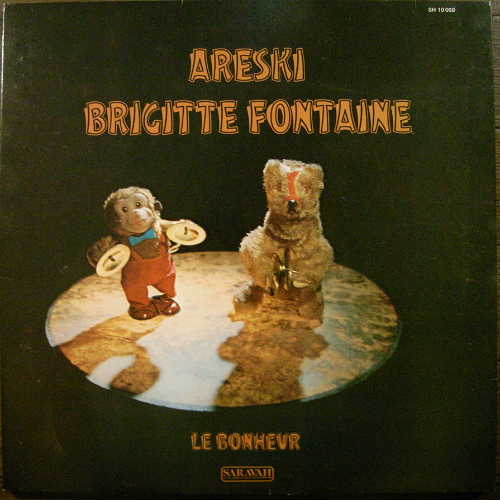
BRIGITTE FONTAINE ET ARESKI - Le Bonheur (1975)
Brigitte Fontaine recorded a solid string of avantfolk albums for the ineffable Saravah label in the seventies that started with her pop-oriented debut, Est Folle... (1968, arranged by Jean-Claude Vannier!). Beginning in the late 60s, Fontaine partnered up with fellow musician/actor Areski Belkacem; the pair continue to record together today. Their records in the 70s were a mix of theatre performance, non-rhyming chanson folk, and a sophisticated confluence of musical styles accentuated by Areski's exotic percussion and the duo's constant experimentation. Le Bonheur is Fontaine and Areski's follow up to L'Incendie (1974), a cult favorite as the years go by and their most cohesive record (not to say cohesive's the gold standard). Areski also joined Fontaine for Comme à la Radio (1970), a mind-blowing collaborative album with the face painting free-jazz troupe, the Art Ensemble of Chicago. Within a minimalist aesthetic, reflected in their sparse 2-track recording style, the pair create a hushed atmosphere and steadfast intimacy that doesn't appear to age. Naturally, Le Bonheur was recorded in the dead of winter in a theater, a kitchen, and also a studio.
February 26, 2011
February 21, 2011
LARRY YOUNG - Contrasts (1967) + Mother Ship (1969)
Larry Young, later Khalid Yasin, was born into his peculiar position as the post-bop era's jazz organist. The Jr. to professional organist Larry Young Sr., Larry was trained by his father in classical and jazz piano from the time he was a toddler. His passion for the organ came when his father opened a nightclub called The Shindig in downtown Newark, New Jersey. Naturally, he had an Hammond organ installed there, and Larry Jr. gravitated to the instrument's distinct qualities. He quickly mastered the difficult Hammond B-3, leading his own jazz combo before he was old enough to play in clubs. He also sang bass for the Operetta Club and local R&B group, the Challengers. By the time he signed to Prestige, he was solely committed to jazz and the Hammond. In 1964, he switched to Blue Note, where his music was heavily influenced by John Coltrane and a shift in his own consciousness. He experimented with drugs, Eastern music, and unique ability to play with resonance and dissonance with the Hammond's modal pedals. At Blue Note, he was given free rein to experiment, but his musical expansion eventually moved beyond jazz as a genre. He began to infuse his music with his earlier influences of R&B and rock 'n' roll, but only to further venture into more experimental realms of musical possibility. After Blue Note decided not to release Mother Ship, Young left the label, converted to Islam, changed his name to Khalid Yasin, and went on to play in some of the most successful experimental jazz-fusion outfits of the 1970s, including Tony Williams' Lifetime Trio (1969-71), Miles Davis' Bitches Brew ensemble (1970), free rock trio, Love Cry Want (1972), even a session with Jimi Hendrix (1969). His sudden death to unknown causes at the age of 37 remains a mystery today, but bears the all too familiar hand of a black ops assassin.
Like the recent blog favorite Lawrence of Newark (1973), Contrasts (1967) was recorded with a large ensemble of musicians Larry knew coming up in Newark. Both albums explore a soul-jazz style reminiscent of first-generation B-3 master, Jimmy Smith, and also Eddie Gale's contemporary Blue Note efforts, yet more experimental than both. Contrasts was largely overlooked upon its release and far less successful than Unity (1965) or Of Love and Peace (1966). It's as free a session as the quartet that created Mother Ship (1969), which was so far out that Blue Note sat on it until 1980, effectively ending their relationship with Young. Both Contrasts and Mother Ship feature saxophonist Herbert Morgan and drummer Eddie Gladden. Lee Morgan completes the quartet on Mother Ship, one of his final Blue Note recordings before being murdered on stage by his ex-common law wife. On these quintessential post-bop records, Larry Young's whoozy organ plays under and over the other instruments, feeling every bit as good as Unity (1964) but occupying the same interstellar space of his free jazz explorations in later years.
CONTRASTS//MOTHER SHIP
February 18, 2011
February 13, 2011
KITCHEN & THE PLASTIC SPOONS - Serve You! (7", 1980) + Icecream to God (Flexidisc, 1981)
Kitchen & the Plastic Spoons formed originally under the name Gdansk after members of Swedish punk bands Psyco and Porno Pop joined with singer Anne Taivanen for a festival gig in Stockholm. They added an extra synth player to become a five piece and self-released their first 7" in 1980. Adding Patrik Lindvall as guitar player in 1981, they released their final record, a flexidisc single, before calling it quits in the fall of that same year. Despite their brief time together, they must have been remarkably active. Besides the several songs found on various compilations, they also recorded many others left unreleased. A few years ago, a compilation of these songs came out on CD, shedding light on just how great and productive this band really was. Kitchen & the Plastic Spoons are the most essential group of Sweden's post punk scene. And "Happy Funeral" is one of the most fun songs of the entire genre.
O look my mother's grave, what a shame
February 9, 2011
February 3, 2011
Politics as Unusual: China Trips the Light Fantastic
The following seeded clouds, lion-tamers, good soldiers, disike dancers, and mounted storks depicted in Communist China's brilliantly exaggerated propaganda posters span from just before Chairman Mao signaled the Cultural Revolution by swimming in the Yangtze River to the Socialist Spiritual Civilization that spawned the Strawberry generation in the 1980s. Rather than merely expect obedience, propaganda posters also gave their blessing, so to speak, to sanctioned ways of having fun as a Communist citizen. Through equal times of desperation and tremendous growth, propaganda remained an important means for China to convey optimism about the Communist future.
Check out the first edition -- Politics As Unusual: Space Is the Chinese Place.
Youthful Dance Steps (1986)///Ge Xing (1989)
Twilight first shines on the military drilling ground (1974)
Face the enemy courageously (1979)///Work the clouds and sow rain to seize a bumper harvest (1976)
White Rabbit Theater Play (1950s)
Xun hu yan yuan (1963)///The lion trainer (1987)
Practice hard to master the ability to kill the enemy, and be ready to combat at any instant (1970)
A ginseng child and sika deer (1987)///Joys of longevity (1983)
SOURCES
Stefan Landsberger has a great collection of Chinese propaganda posters
Additional Chinese propaganda posters reside here by the gobs.
January 29, 2011
عطلة غامضة: Master Mahwash
Ustad Farida Mahwash (فریده مهوش), singer from Kabul Afghanistan, 198?. In 2006, she became the first woman in Afghanistan to be given the honorary title of Ustad (master). She currently resides in California, USA.
January 26, 2011
FACTUMS - Gilding the Lilies CS (2010)
With new Gregorian years come new thoughts about old practices. Or maybe it's the simple fact that the best band in America has released a new cassette, and it's so essential to American survival as to best this blog's resolve not to post newly released musics. This being a singular case up to this point, I suppose it's only proper Murky Reset take this opportunity to say, if the creators or monied disseminators thereof take issue with this digital representation of an otherwise analog cultural artifact, kindly cable me via interweb and it will be removed from the sight directly. Specifically, this prerogative would extend to Shawn Reed, member of Wet Hair and owner of the Night People label, and also, of course, Factums.
Whether it's Factums, Rodent Plague, Intelligence, AFCGT, or Children's Hospital, there is a loose group of dudes in Seattle who make warped eleki buumu noise rock I tend to wait each year for with bated breaths. So naturally when I heard Factums had a 2XLP coming out in 2010, I wasn't mad at em. Searched though as I may, I never have seen or put my hands on this item. Instead, what we have here is a cassette with the same songs purported to be on said album, but with a different track order. I don't know if these are the same or different versions of those songs, but the Gilding the Lilies c45 will certainly do for now. It's Factums' best effort yet, and this blog's favorite release from said dudes since the AFCGT CD-R (2008). The boggy analog bliss this tape grooves in makes like a lost tape from Vanity Records, and yet it sounds singularly inevitable, like timeless. People need to hear this.
Guilting the Lilylivers
January 23, 2011
Bezunèsh Bèkèlè - Yenat Weletawa (197?)
If you have ever looked for and found the name Bezunèsh Bèkèlè on your Ethiopiques 13 CD or searched out her Greatest Hits compilation, then you'll likely to drool when you hear this album. For those less familiar with the "First Lady" of Addis Ababa's Golden Era, she started performing as early as the 1950s and was the first female singer in the tumultuous capital city to go modern. She gained great popularity as a singer for the Imperial Body Guard Band, and her success continued well into the 1970s. Most of the great Ethiopian musicians of this time played for institutional bands like the Army or Police orchestras. The Imperial Body Guard attempted to overthrow Emperor Haile Selassie in the early sixties, and failed. As a result, the emperor removed the band's 'imperial' title, and the "Golden Age" of Ethiopian pop was ushered in by smaller bands free to self-organize.
The songs featured on this collection were probably first released in the early 70s, though I can't say for sure. The heavy horns, perhaps the Body Guard Band or Dahlak Band, outmatch James Brown for hard fevered funk and Bezu's liltingly casual style belies the reedy sensuality of her voice. The sleeve pictured above, which is from a Philips-Ethiopia 45, is not the official cover for this collection, which is either a bootleg or perhaps released in a neighboring country. If you have more information about Bezunèsh Bèkèlè or this compilation in particular, you are welcome to write in.
ብዙነሽ በቀለ
January 22, 2011
SCIENCE PATROL - Bandit Ducks From Outer Space 7" (1981)
I noticed in posting Zru Vogue's first album and 7" that the band's side opus, which had been hosted at 7" from the undergound for a time, had apparently expired its hyperlinkage. Many of these great blogs that have given heads so much sound over the years are beginning to show signs of decay. My recent way of thinking has been that anyone inclined to share these old digital artifacts should do so for the sake of posterity. I personally have never found offense in people piggybacking any offerings of mine own. There's a time for honor among thieves, and perhaps a time to rally to fort so that a stable exchange of global goodness might be gained through the proliferation of personal computer storage and subsequent sharings under whatever internet paradigm that might befall us. At any rate,
Science Patrol's original lineup was Andrew L. Jackson, known here as Andrew 'Our Hero' Finkle, and two fellas known as Pity and Spike. The band got its name from the 60s Japanese TV series, Ultraman. Later Jackson's partner in Zru Vogue, Rick Cuevas, and a guy called Dad joined the group, and they started playing out in the Bay Area. The group infused electro-funk synth noise with rap freestyling, Dada-inspired video art, and a Mattel Magical Musical Thing. Jackson and Cuervas started their own label to release Science Patrol's Bandit Ducks From Outer Space, the group's only 7" which has since become a much sought after item. It's hard to say what's so addictive about these two slabs of experimental post-punk funk. The songs tread territory somewhere between Vox Populi! and Dark Day. On "Pop ABCD"—four songs mashed together on the single's B-side—Science Patrol chose random lines from Tristan Tzara poems for the lyrics. Their first single, "Virgil Wilson," about a real person who had a tracheotomy, featured electronically mutilated vocals. The group eventually killed the Magical Musical Thing and looped the sound of its destruction through their Korg synthesizer, along with everything else. Feeding the guitar through the Korg created a clean and creeepy guitar tone that can also be heard in Zru Vogue.
Hep Hep
Labels:
.Bay Area Post Punk,
.Post Punk,
Science Patrol,
Zru Vogue
ZRU VOGUE - Zru Vogue (LP, 1982) + Nakweda Dream (7", 1981)
Form a new religion/Feed it to the pigeons
Palo Alto's avant-pop darlings Zru Vogue have wooed many an ear with "Nakweda Dream," their woozy independent single voted best by Sub Pop in 1981. The lyrics, some of Murky Reset's favorite of times, were supposedly produced out of Dada sessions and generated on the spot, as is more aptly demonstrated on single's tribal B-side, "Cumulonimbus." The band was essentially a collaboration between grade school pals Rick Cuevas and Andrew Jackson, who continue to play together today as Zru Vogue. They put out their debut LP in 1982, a seemingly more straight-forward new wave effort that descends into funky Liquid Liquid-like territory and ends with "Do the Zru," a dark Dada dance mashup that exemplifies the band's potent joy-creation. They started Zero Risk Records in 1981 to release Zru Vogue (1982) and also to put out their side project Science Patrol's first and only 7", Bandit Ducks from Outer Space (1981), an experimental synth-psych masterpiece that bears well under the duress of obsessive listening, as I can personally attest to. Cuevas and Jackson have been kind enough to compile Zru Vogue's early demos and proffer them here freely.Study Pataphysics
Labels:
.Bay Area Post Punk,
.Post Punk,
.Zru Vogue,
Science Patrol
January 16, 2011
This Man Made Art Because He Couldn't Help Himself: Steve Ashby's 'Fixing-Ups'
Train In Landscape, 19??
"I wake up with an idea that won't let me get back to sleep. So I get up and make that idea."
The son of a freed slave, Steve Ashby was born in 1904 in Delaplane, Virginia, and never left his hometown. He started working as a farmhand with his father when he was still young. He later worked as a gardener and a hotel waiter before his retirement in the 1950s. After his wife died, had many idle hours. When he made his first life-size sculpture of her likeness, dressed in her clothes from panties to outer wear, the neighbors were shocked at first to see her tending to her daily chores again. He took to making smaller "fixing-ups" that he produced prodigiously out of wood, and found objects like magazine cutouts, tool parts, fabric, marbles, and toys. These art objects, many designed with whirlygigs and moveable parts, ranged from the expressive to the pornographic fantasy, and were often a vehicle for Ashby's keen eye for social details. He stuck an assortment of his sculptures in the ground, on the fence, and in the trees around his yard. The pornographic cutouts were kept under his bed, shared only with great reluctance. The droll perceptiveness of his work is all the more accentuated by the crudenss of the carving. The characters, caught in the middle of their mundane daily lives seem imbued with laughter and terror in equal amounts. Since his death in 1980, Steve Ashby's work has been in many exhibitions of outsider art around the country, and he has been anthlogized in several books on African-American folk art.
Untitled, 19??
Untitled, 197?
Untitled (Cat's Head), 1970s
Pregnant Woman, late 1960s
January 9, 2011
December 25, 2010
December 24, 2010
2010 - Year In Music
I hope, in the year since my last list of annual favorites, my lack of interest in criticism has been duly indicated. And I don't profess to have heard enough new music to know what my favorite albums of 2010 will be in 2011. At any given time, there are people in far-off places doing amazing things. If ever you feel cynical about the current state of artistic achievement, you should question first your quantum approach, not the liveliness of humankind, which clutters every corner of the world with wonders, just like its human streams of shit. So, fully acknowledging a lack of interest at the moment for listing things, here are musics released commerically this year that I most enjoyed concurrent to this year, 2010:
+current outfits+
•MI AMI • Steal Yr Face
•NAKED ON THE VAGUE • Heaps of Nothing
•NOTHING PEOPLE • Soft Crash
•FACTUMS • GILDING THE LILIES C45
•BALACLAVAS • Roman Holiday
•SOFT MOON • Soft Moon
•D-W/L-SS / JBe • Split 7"
•GROUP DOUEH • Beatte Harab
•BLANK DOGS • Land and Fixed + Phrases 12"
•ARIEL PINK'S HAUNTED GRAFFITI • Before Today
•WHITE RING • Black Earth That Made Me
•HAYVANLAR ALEMI • Guarana Superpower
•LA VAMPIRES MEETS ZOLA JESUS• LA Vampires Meets Zola Jesus
•BLACK ORPHAN •Metal Leg 7"
•INDIAN JEWELRY • Totaled
•MOON DUO/BITCHIN' BAJAS • Split 7"
•A F C G T • A F C G T
•SILVESTER ANFANG II • Communen Cassetten
•WUMME • ROG CD-R
Ummm... Did I happen to say?
•OLSON TWINS & CO.• Gimme Pizza (Chopped & Screwed)
+once old now new again+
•EMAK • A Synthetic History of EMAK (1982-1988)
•SAM SPENCE • Sam Spence Sounds
•OMAR KHORSHID • Guitar El Chark
•MARIKA PAPAGIKA • The Further the Flame, the Worse It Burns Me
•NEON JUDGMENT • Early Tapes
•ABNER JAY • The Original Folk Song Style of Abner Jay
•ROB JO STAR BAND • Rob Jo Star Band
•VA//Brazilian Guitar Fuzz Bananas: Tropicalia Psychedelic Masterpieces 1967-1976
•VA//The World Ends: Afro Rock & Psychedelia In 1970s Nigeria
•VA//Afro-Beat Airways: West African Shock Waves--Ghana & Togo 1972-1979
•VA//The Sound Of Siam: Leftfield Luk Thung, Jazz & Molam from Thailand 1964 -75
•VA//Luk Thung! (The Roots Of Thai Funk)
•VA//Music from Saharan Cellphones Vol.1 + Vol. 2
•VA//Excavated Shellac: Strings--Guitar, Oud, Tar, Violin and More from the 78rpm era
•VA//The World Is A Monster: Columbia Hillbilly 1948-58
•VA//Field Recordings From Alan Lomax's Southern Journey 1959-60 , Vols. 1-5
•VA//Been Here All My Days: Selections From The George Mitchell Archive
•VA//Written In Blood, Vols. 1-5
•VA//Turkish Freakout (Psych-Folk Singles 1969-80)
•VA//Dengue Fever presents: Electric Cambodia
•VA//Vanity Records: Finest Selection 1978 to 1981
•VA//Roots of Chicha 2: Psychedelic Cumbias From Peru
•VA//Cumbia Beat, Vol. 1: Experimental Guitar-Driven Tropical Sounds From Peru 1966-1978
•VA//Peoples' Potential Unlimited Family Album
•VA//Saigon Rock & Soul: Vietnamese Classic Tracks 1968-1974
Subscribe to:
Comments (Atom)


