The fact that Tsehay Yohannes (ፀሃየ ዮሃንስ) has not been featured on the voluminous Ethiopiques series is a testament to the richness of Ethiopia's musical history. Born in 1961, Yohannes (also spelled Yohanis) started singing for the Kebur Zebegna band at age 14 and recorded his debut album, Tey Munit, in 1974. He later played with the Roha Band and Dadimos Band. Having grown up in Tigrai but born in Gondar, Yohannes sang both in Amharic and Tigrinya and promoted cultural unity in his lyrics. Great dissension remains today between separatist Eritreans, Habesha, and Ethiopians alike. Because Amharic is considered an invasive language to the other cultures, illiteracy is a complicated issue in Ethiopia. Yohannes' hit song "Berta Zemede," a tribute to activist Edeget Beheberet Zemecha, became the official theme for the the "Manbebena Mestaf" and "Meseret Temehert" movements which almost doubled the literacy rate of the country in the 70s and 80s. He released a new album in 2007 and continues to perform today. The videos below range from fried psych funk to the more traditional and show this electric performer's full range as well as his special way of singing with his hands.
***
• See more of the amazing Tsehay Yohannes hear, hear, hear, hear, and hear.
• Wade deeper into Murky Recess' ongoing ግልጽ ያልሆነ ጉድጓድ series.
• Visit the man's lionizing website.
• A partial discography is posted in the Comments Section.
Not long after moving to the city in the 1975, Steve Treatment fell in with the glam kids who haunted Marc Bolan's central London office, most of whom would people London's punk scene in the years to come. Steve became fast friends with Nikki Sudden, who had already started Swell Maps with his brother, Epic Soundtracks. Steve and Nikki became kind of Bolan's main youngblood associates. It was by their heed that T. Rex brought The Damned on the Dandy in the Underworld tour in 1977. As an interesting aside, Steve Treatment also caught the eye of director Derek Jarman at this time. He helped Jarman cast Jubilee by serving as liason with London's punk kids and can himself be seen in Jubilee's bonfire scene.
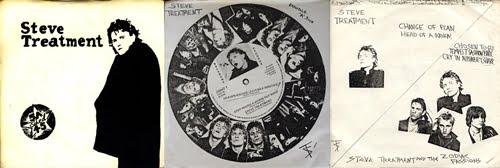
With the success of Swell Maps' first single in 1977—released on their own Rather Records—they started to put out music from other bands. Rather's second release was Steve Treatment's debut EP, 5A-Sided 45. Swell Maps served as Treatment's backing band on this record, but you'd hardly be able to tell. Stripped to their essential core, some of these songs have just one or two chords and were recorded in as many takes. The slipshod approach imbues the record with that infectious joy of creating. Everything's drowned in reverb and rendered weird by Treatment's double-tracked vocals, and yet his Bolan kick remains front and center. In fact, an engraving on the run-out groove says "BOLAN WAS STOLEN." Steve Treatment never once played out for these records, despite finding some success on the independent charts. He self-released two more 45s on his own Backbone Records, delving even further into rock'n'roll hysteria. His double vocals can even be heard arguing with each other at the end of "Step Into a Worn Out Shoe!" Treatment would go on to play with Ticket Inspectors in the late 80s and early 90s but didn't release music under his own name again for 25 years. He has become quite active in the past ten years, releasing new music on Messthetics and, in 2006, a CDR compilation of his early recordings.
I want to extend heartfelt appreciation to Doug from Give the Drummer Some on WFMU for devoting an hour of his show to music posted here at Murky Recess. To receive praise from a brother strange to you is beautiful indeed. If you are not already a follower of Doug's ongoing series, Mining the Audio Motherlode, I advise you rectify your unfortunate situation sooner than later.
When Cambodia's King Norodom Sihanouk gave her the official title, "Queen of Golden Voice," Ros Sereysothea was the most popular female singer in Phnom Penh's psychedelic scene; but ultimately her life was an unhappy one. Born Ros Sothea to a large family in the Battabong province, Sothea's father walked out early on, leaving her mother struggling to provide for her five children. As a way to help support the family, Sothea sold boiled snails in the village and was often heard singing as she walked from place to place. In fact, her family sang and performed to earn extra money; Sothea and her brother, Serey, became known throughout the area for their powerful voices, even winning local singing contests. Sothea would eventually pay tribute to her brother by combining their names.
Changing her name when she moved to Phnom Penh to pursue a music career, Ros Sereysothea sang in a variety of restaurants and bars before catching the attention of Sinn Sisamouth, the most popular male singer in Cambodia. She recorded her first single in 1967 and a number of duets with Sisamouth, eventually catching the ear of the once and future King Norodom Sihanouk (Sihanouk was ousted in 1970 by the Lon Nol government, reinstated by the Khmer Rouge in 1975, ousted again, and reinstated in 1993). Starting in the 60s with the invasion of Vietnam, the US Armed Forces Radio broadcast pop and rock songs throughout the region, including Phnom Penh, where many people fled during the US bombings of rural areas in Cambodia. Inspired by these new sounds, Western-inspired bands popped up around the city, infusing traditional Khmer songs with Anglo pop hooks. The most hopeful time in Sereysothea's life was in the early 70s when she fell in love with a parachutist for the Lon Nol government. She experimented freely with different musical styles, starred in a few movies, and became a consummate parachutist with the help of her lover. After the Khmer Rouge under Pol Pot took power in 1975, they sought to purge the country of Western influence. Sereysothea was kidnapped in 1977 and treated with great cruelty. She was forced to dig ditches, sing revolutionary songs for the new regime, and married against her will to one of Pol Pot's assistants, who savagely beat. Her whereabouts after 1978 are unclear, but there were rumors she was found shackled and starved in one of the rural work camps. Another account found her cleaning out the pens at an industrial pig farm and subjected to general humiliation. Regardless, she was never heard or seen from again and most likely died, along with her family, at the hands of Khmer Rouge.
The songs compiled on this collection are inspired by Sereysothea's haunting voice in light of her tragic life. It should be noted that these are not original recordings, but rather products of the karaoke lip-syncing phenomenon endemic to Southeast Asia. Chlangden pop is the pervasive and ribald practice of adding a drum machine track and sometimes other instruments over a classic tune to make the song "new" again. Primarily used in karaoke bars, these songs have been reviled, justifiably, both for their disrespectful treatment of cultural history and also for ruining many songs by drowning out the vocals and muddying the tracks. Just the same, it is almost impossible to have access, in Cambodia as well as in the West, to many of the original recordings. Culled from over 300 hundred Chlangden tracks, Boiled Snail Girl offers songs more or less unavailable in any other form. While far from substituting the originals, Chlangden appropriations like "saryka prot ku" and "lolok sor kut" showcase Ros Sereysothea's fearless experimentation while offering a transcendently mutant view into how classic Khmer singers continue to live on in Cambodian culture today.
រស់ សេរីសុទ្ធា
[Tracklist is provided in Comments in both anglicized and Khmer form; any help with translation would be greatly appreciated.]
Sali Sidibé is one of the best-known kamalen n'goni singers from Mali's southern Wassoulou region. Since the 90s, her Wassalou-pop style has made her popular in the West, exemplified by the Divas from Mali (1997) compilation. She was a forerunner in modernizing the n'goni style and her contemporary music has since become available the world over. And yet any trace of her prior career, purported to span over 30 years, has been more or less lost to the ether—until now. worldservice has only recently proffered the hard proof that Sali Sidibé indeed recorded as early as the late 70s and possibly even the 60s. I'll leave it to wrldsrv to expound upon the particulars, but suffice it to say that the two rescued artifacts there posted provide ample claim to Sidibé as a godmother of modern n'goni and a matchless singer. Let this be the quintessential example of how music blogs are creating new canons and rescuing histories from oblivion.
Memorial portraitures, otherwise known as memento mori, were a common means of remembering loved ones in America until the turn of the 20th century; it is still popular in parts of the world.
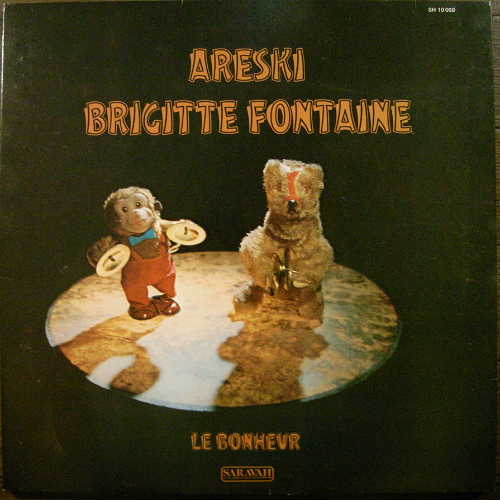
Brigitte Fontaine recorded a solid string of avantfolk albums for the ineffable Saravah label in the seventies that started with her pop-oriented debut, Est Folle... (1968, arranged by Jean-Claude Vannier!). Beginning in the late 60s, Fontaine partnered up with fellow musician/actor Areski Belkacem; the pair continue to record together today. Their records in the 70s were a mix of theatre performance, non-rhyming chanson folk, and a sophisticated confluence of musical styles accentuated by Areski's exotic percussion and the duo's constant experimentation. Le Bonheur is Fontaine and Areski's follow up to L'Incendie (1974), a cult favorite as the years go by and their most cohesive record (not to say cohesive's the gold standard). Areski also joined Fontaine for Commeà la Radio (1970), a mind-blowing collaborative album with the face painting free-jazz troupe, the Art Ensemble of Chicago. Within a minimalist aesthetic, reflected in their sparse 2-track recording style, the pair create a hushed atmosphere and steadfast intimacy that doesn't appear to age. Naturally, Le Bonheur was recorded in the dead of winter in a theater, a kitchen, and also a studio.
Larry Young, later Khalid Yasin, was born into his peculiar position as the post-bop era's jazz organist. The Jr. to professional organist Larry Young Sr., Larry was trained by his father in classical and jazz piano from the time he was a toddler. His passion for the organ came when his father opened a nightclub called The Shindig in downtown Newark, New Jersey. Naturally, he had an Hammond organ installed there, and Larry Jr. gravitated to the instrument's distinct qualities. He quickly mastered the difficult Hammond B-3, leading his own jazz combo before he was old enough to play in clubs. He also sang bass for the Operetta Club and local R&B group, the Challengers. By the time he signed to Prestige, he was solely committed to jazz and the Hammond. In 1964, he switched to Blue Note, where his music was heavily influenced by John Coltrane and a shift in his own consciousness. He experimented with drugs, Eastern music, and unique ability to play with resonance and dissonance with the Hammond's modal pedals. At Blue Note, he was given free rein to experiment, but his musical expansion eventually moved beyond jazz as a genre. He began to infuse his music with his earlier influences of R&B and rock 'n' roll, but only to further venture into more experimental realms of musical possibility. After Blue Note decided not to release Mother Ship, Young left the label, converted to Islam, changed his name to Khalid Yasin, and went on to play in some of the most successful experimental jazz-fusion outfits of the 1970s, including Tony Williams' Lifetime Trio (1969-71), Miles Davis' Bitches Brew ensemble (1970), free rock trio, Love Cry Want (1972), even a session with Jimi Hendrix (1969). His sudden death to unknown causes at the age of 37 remains a mystery today, but bears the all too familiar hand of a black ops assassin.
Like the recent blog favorite Lawrence of Newark (1973), Contrasts (1967) was recorded with a large ensemble of musicians Larry knew coming up in Newark. Both albums explore a soul-jazz style reminiscent of first-generation B-3 master, Jimmy Smith, and also Eddie Gale's contemporary Blue Note efforts, yet more experimental than both. Contrasts was largely overlooked upon its release and far less successful than Unity (1965) or Of Love and Peace (1966). It's as free a session as the quartet that created Mother Ship (1969), which was so far out that Blue Note sat on it until 1980, effectively ending their relationship with Young. Both Contrasts and Mother Ship feature saxophonist Herbert Morgan and drummer Eddie Gladden. Lee Morgan completes the quartet on Mother Ship, one of his final Blue Note recordings before being murdered on stage by his ex-common law wife. On these quintessential post-bop records, Larry Young's whoozy organ plays under and over the other instruments, feeling every bit as good as Unity (1964) but occupying the same interstellar space of his free jazz explorations in later years.
Kitchen & the Plastic Spoons formed originally under the name Gdansk after members of Swedish punk bands Psyco and Porno Pop joined with singer Anne Taivanen for a festival gig in Stockholm. They added an extra synth player to become a five piece and self-released their first 7" in 1980. Adding Patrik Lindvall as guitar player in 1981, they released their final record, a flexidisc single, before calling it quits in the fall of that same year. Despite their brief time together, they must have been remarkably active. Besides the several songs found on various compilations, they also recorded many others left unreleased. A few years ago, a compilation of these songs came out on CD, shedding light on just how great and productive this band really was. Kitchen & the Plastic Spoons are the most essential group of Sweden's post punk scene. And "Happy Funeral" is one of the most fun songs of the entire genre.
The following seeded clouds, lion-tamers, good soldiers, disike dancers, and mounted storks depicted in Communist China's brilliantly exaggerated propaganda posters span from just before Chairman Mao signaled the Cultural Revolution by swimming in the Yangtze River to the Socialist Spiritual Civilization that spawned the Strawberry generation in the 1980s. Rather than merely expect obedience, propaganda posters also gave their blessing, so to speak, to sanctioned ways of having fun as a Communist citizen. Through equal times of desperation and tremendous growth, propaganda remained an important means for China to convey optimism about the Communist future.
Ustad Farida Mahwash (فریده مهوش), singer from Kabul Afghanistan, 198?. In 2006, she became the first woman in Afghanistan to be given the honorary title of Ustad (master). She currently resides in California, USA.
With new Gregorian years come new thoughts about old practices. Or maybe it's the simple fact that the best band in America has released a new cassette, and it's so essential to American survival as to best this blog's resolve not to post newly released musics. This being a singular case up to this point, I suppose it's only proper Murky Reset take this opportunity to say, if the creators or monied disseminators thereof take issue with this digital representation of an otherwise analog cultural artifact, kindly cable me via interweb and it will be removed from the sight directly. Specifically, this prerogative would extend to Shawn Reed, member of Wet Hair and owner of the Night People label, and also, of course, Factums.
Whether it's Factums, Rodent Plague, Intelligence, AFCGT, or Children's Hospital, there is a loose group of dudes in Seattle who make warped eleki buumu noise rock I tend to wait each year for with bated breaths. So naturally when I heard Factums had a 2XLP coming out in 2010, I wasn't mad at em. Searched though as I may, I never have seen or put my hands on this item. Instead, what we have here is a cassette with the same songs purported to be on said album, but with a different track order. I don't know if these are the same or different versions of those songs, but the Gilding the Lilies c45 will certainly do for now. It's Factums' best effort yet, and this blog's favorite release from said dudes since the AFCGT CD-R (2008). The boggy analog bliss this tape grooves in makes like a lost tape from Vanity Records, and yet it sounds singularly inevitable, like timeless. People need to hear this.
If you have ever looked for and found the name Bezunèsh Bèkèlè on your Ethiopiques 13 CD or searched out her Greatest Hits compilation, then you'll likely to drool when you hear this album. For those less familiar with the "First Lady" of Addis Ababa's Golden Era, she started performing as early as the 1950s and was the first female singer in the tumultuous capital city to go modern. She gained great popularity as a singer for the Imperial Body Guard Band, and her success continued well into the 1970s. Most of the great Ethiopian musicians of this time played for institutional bands like the Army or Police orchestras. The Imperial Body Guard attempted to overthrow Emperor Haile Selassie in the early sixties, and failed. As a result, the emperor removed the band's 'imperial' title, and the "Golden Age" of Ethiopian pop was ushered in by smaller bands free to self-organize.
The songs featured on this collection were probably first released in the early 70s, though I can't say for sure. The heavy horns, perhaps the Body Guard Band or Dahlak Band, outmatch James Brown for hard fevered funk and Bezu's liltingly casual style belies the reedy sensuality of her voice. The sleeve pictured above, which is from a Philips-Ethiopia 45, is not the official cover for this collection, which is either a bootleg or perhaps released in a neighboring country. If you have more information about Bezunèsh Bèkèlè or this compilation in particular, you are welcome to write in.






 Posts
Posts


