Showing posts with label .Post Punk. Show all posts

December 30, 2011

Chiko Hige x Kaoru Sato + Chiko Hige x Kaoru Sato 12" (1985)


I mentioned this record by Chiko and Kaoru in the earlier EP-4 post, where I linked to its original blog progenitor  Music is a Better Noise. The link there has since expired, so I hope min min won't mind I proffer here with love and spaghetti for good friend F. Strap, Esq.

Just to rehash: Chiko Hige played the drums and sax, first in the early 70s avant-garde ensemble 3/3. He and bandmate Reck then moved to New York, where Chiko played in The Contortions. Reck played with Lydia Lunch in Teenage Jesus & the Jerks. Eventually they both moved back to Japan and formed Friction, a crazy band with a crazy deam. Chiko Hige released solo material as well: the Killer Wood 12" (1982)—which I would love to hear—and Trap (1985). 

Kaoru Sato recorded RNA Organism (1980) when he was 19, releasing just the one LP and a compilation track. He started EP-4 around the same time, and also served as producer for some of the wildest 80s underground groups in Japan, free of charge when necessary.

This eponymous collaboration really bears the influence of both musicians equally. Hige played drums, bass, and sax; Sato contributed vocals, noise, and percussion. The lyrics are all taken from Taro Tominaga, a 20th-century poet influenced by Baudelaire.

• For fellow Kaoru Sato fanatics, I may or may not have found an EP-4 twitter feed? @mEssed_uP_4


チコヒゲ + 薫里

September 23, 2011

EP-4 - Partial Discography (1983-1985)


EP-4 formed in 1980 out of a scene at Club Modern in Kyoto, mainly a collaboration between Kaoru Sato and keyboardist/tape manipulator Banana Kawashima. Sato had already released an album earlier that same year as RNA Organism for Osaka's Vanity Records. RNA Organism, along with the rest of the Vanity catalog, has a sound unto itself, as though from a parallel plane and more difficult to put into words. EP-4 are easier to define, having described their own sound as "cool, no-sweat funk." While it's true funk is the driving force, farther-flung realms are visited. Skeletal grooves become increasingly drenched in compressed and distorted sound, evolve almost biologically. EP-4 is, as it were, the 'power of the four elements,'

The band released an LP—Lingua Franca-1 (昭和大赦)—on both a major and independent label simultaneously, using secret shows and other guerrilla marketing strategies to get the word out. The album name caused contentious political debate, even calls for censorship, when it was learned the subtitle was 昭和崩御 [Death to Emperor Showa]. EP-4 eventually changed it to 昭和大赦 [Amnesty for Emperor Showa], a kind of underhanded capitulation. They saved the more treasonous subtitle for Lingua Franca-X (昭和崩御), which came with a strange booklet of poetry:

Revelations of the salt which flows in flesh,    
The white trace revealed like a secret mark
It calls on belief in a creative sea,
The possibility of the first Christ figure
We look at the sea's solaris dream
The human love of distant objects    
Has changed into concrete
The love which does not designate distance as distance
That cell

—from "Life Tides" [rough translation] 
 
After Lingua Franca-1, EP-4 released a handful of 12"s, cassettes, live bootlegs, and singles before disbanding around 1985(?). Sato and Banana played together in a few other projects, notably: Chiko Hige × Kaoru Sato (a collaboration with the drummer of Friction and formerly the Contortions), and Tako, a one-off album of acid punk, new wave, bizarre sound experiments, and a motley amalgam of other weirdness.  


MAIN DISCOGRAPHY
•Lingua Franca-1 (昭和大赦) LP (1983)
•Lingua Franca-2 (1983??)
•Lingua Franca-X (昭和崩御) 12" (1984)
•Found Tapes 12" (1984)
•Five to One 12" (1985)
•The Crystal Monster 12" (1985)

MORE
•Seifuku Nikutai ??? (1983)
•Multilevel Holarchy: A Collection of Live Recordings  from 1980 to 1983 12" (1983)
•Costume, Corps, Copy (live cassette) (1983)
•appears on VA//Case of Telegraph: Product 2 (1983)
•5.21 split 7" (w/ Grim Skip) (1985)

(Holler if you know of additional information or can otherwise fill in the blanks.)

• My biggest thanks to Music Is A Better Noise for giving us the bulk of EP-4's catalog and many other artifacts from Japan's underground.
• Readers of Japanese can find a wealth of additional EP-4 info and materials here.


July 16, 2011

C.O.M.A - Coma (1979)


Seriously, how great is that cover? Before becoming French pop star Charles de Goal, Patrick Blain was part of C.O.M.A, an electropunk band that recorded one bizarre album, chock with ideas, then dismantled shortly after. Some will find similarities to Metal Urbain in their sound, especially tracks like "Assaut," but C.O.M.A is perhaps the stranger, dumber beast—an eclectic mix of clangy guitar punk, proto-industrial synth, harmonica, and slapdash electronic drums. Each song is its own experiment.

To my ears, Charles de Goal's distinctive guitar sound has always separated them from their new wave contemporaries in France. You can hear the auspice of that tone in C.O.M.A.  Blain started Charles de Goal just a year after this release, but it wasn't until 1984 that the group crossed over into the mainstream. In 1983, Blain reconvened with C.O.M.A members Philippe Huart and Philippe Ross as Danse Macabre (one of several Danse Macabres of the era) for another one-off album, a very cool untitled 12" ← dark, like early industrial, with that dense experimental atmosphere the French do best. Danse Macabre reunited in the '00s and Charles de Goal released a new album in 2008. 


Clinik Organic Muzak Anatomik


March 27, 2011

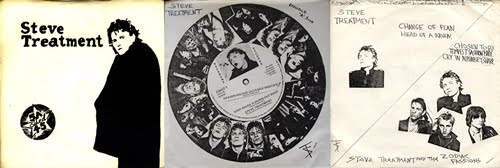
STEVE TREATMENT - 5A-Sided 45 (1978) + Heaven Knows (Juvenile Wrecks) 7" (1979) + Change of Plan 7" (1979)


Not long after moving to the city in the 1975, Steve Treatment fell in with the glam kids who haunted Marc Bolan's central London office, most of whom would people London's punk scene in the years to come. Steve became fast friends with Nikki Sudden, who had already started Swell Maps with his brother, Epic Soundtracks. Steve and Nikki became kind of Bolan's main youngblood associates. It was by their heed that T. Rex brought The Damned on the Dandy in the Underworld tour in 1977. As an interesting aside, Steve Treatment also caught the eye of director Derek Jarman at this time. He helped Jarman cast Jubilee by serving as liason with London's punk kids and can himself be seen in Jubilee's bonfire scene.

With the success of Swell Maps' first single in 1977—released on their own Rather Records—they started to put out music from other bands. Rather's second release was Steve Treatment's debut EP, 5A-Sided 45. Swell Maps served as Treatment's backing band on this record, but you'd hardly be able to tell. Stripped to their essential core, some of these songs have just one or two chords and were recorded in as many takes. The slipshod approach imbues the record with that infectious joy of creating. Everything's drowned in reverb and rendered weird by Treatment's double-tracked vocals, and yet his Bolan kick remains front and center. In fact, an engraving on the run-out groove says "BOLAN WAS STOLEN." Steve Treatment never once played out for these records, despite finding some success on the independent charts. He self-released two more 45s on his own Backbone Records, delving even further into rock'n'roll hysteria. His double vocals can even be heard arguing with each other at the end of "Step Into a Worn Out Shoe!" Treatment would go on to play with Ticket Inspectors in the late 80s and early 90s but didn't release music under his own name again for 25 years. He has become quite active in the past ten years, releasing new music on Messthetics and, in 2006, a CDR compilation of his early recordings.


I don't understand why you bit the head off a raven

February 26, 2011

El Aviador Dro Y Sus Obreros Especializados

See also Aviador Dro's occult synth side project Los Iniciados.

¿Quieres  más?

February 13, 2011

KITCHEN & THE PLASTIC SPOONS - Serve You! (7", 1980) + Icecream to God (Flexidisc, 1981)


Kitchen & the Plastic Spoons formed originally under the name Gdansk after members of Swedish punk bands Psyco and Porno Pop joined with singer Anne Taivanen for a festival gig in Stockholm. They added an extra synth player to become a five piece and self-released their first 7" in 1980. Adding Patrik Lindvall as guitar player in 1981, they released their final record, a flexidisc single, before calling it quits in the fall of that same year. Despite their brief time together, they must have been remarkably active. Besides the several songs found on various compilations, they also recorded many others left unreleased. A few years ago, a compilation of these songs came out on CD, shedding light on just how great and productive this band really was. Kitchen & the Plastic Spoons are the most essential group of Sweden's post punk scene. And "Happy Funeral" is one of the most fun songs of the entire genre.


O look my mother's grave, what a shame

January 22, 2011

SCIENCE PATROL - Bandit Ducks From Outer Space 7" (1981)


I noticed in posting Zru Vogue's first album and 7" that the band's side opus, which had been hosted at 7" from the undergound for a time, had apparently expired its hyperlinkage. Many of these great blogs that have given heads so much sound over the years are beginning to show signs of decay. My recent way of thinking has been that anyone inclined to share these old digital artifacts should do so for the sake of posterity. I personally have never found offense in people piggybacking any offerings of mine own. There's a time for honor among thieves, and perhaps a time to rally to fort so that a stable exchange of global goodness might be gained through the proliferation of personal computer storage and subsequent sharings under whatever internet paradigm that might befall us. At any rate,

Science Patrol's original lineup was Andrew L. Jackson, known here as Andrew 'Our Hero' Finkle, and two fellas known as Pity and Spike. The band got its name from the 60s Japanese TV series, Ultraman. Later Jackson's partner in Zru Vogue, Rick Cuevas, and a guy called Dad joined the group, and they started playing out in the Bay Area. The group infused electro-funk synth noise with rap freestyling, Dada-inspired video art, and a Mattel Magical Musical Thing. Jackson and Cuervas started their own label to release Science Patrol's Bandit Ducks From Outer Space, the group's only 7" which has since become a much sought after item. It's hard to say what's so addictive about these two slabs of experimental post-punk funk. The songs tread territory somewhere between Vox Populi! and Dark Day. On "Pop ABCD"—four songs mashed together on the single's B-side—Science Patrol chose random lines from Tristan Tzara poems for the lyrics. Their first single, "Virgil Wilson," about a real person who had a tracheotomy, featured electronically mutilated vocals. The group eventually killed the Magical Musical Thing and looped the sound of its destruction through their Korg synthesizer, along with everything else. Feeding the guitar through the Korg created a clean and creeepy guitar tone that can also be heard in Zru Vogue.


Hep Hep


ZRU VOGUE - Zru Vogue (LP, 1982) + Nakweda Dream (7", 1981)


 Form a new religion/Feed it to the pigeons

Palo Alto's avant-pop darlings Zru Vogue have wooed many an ear with "Nakweda Dream," their woozy independent single voted best by Sub Pop in 1981. The lyrics, some of Murky Reset's favorite of times, were supposedly produced out of Dada sessions and generated on the spot, as is more aptly demonstrated on single's tribal B-side, "Cumulonimbus." The band was essentially a collaboration between grade school pals Rick Cuevas and Andrew Jackson, who continue to play together today as Zru Vogue. They put out their debut LP in 1982, a seemingly more straight-forward new wave effort that descends into funky Liquid Liquid-like territory and ends with "Do the Zru," a dark Dada dance mashup that exemplifies the band's potent joy-creation. They started Zero Risk Records in 1981 to release Zru Vogue (1982) and also to put out their side project Science Patrol's first and only 7", Bandit Ducks from Outer Space (1981), an  experimental synth-psych masterpiece that bears well under the duress of obsessive listening, as I can personally attest to. Cuevas and Jackson have been kind enough to compile Zru Vogue's early demos and proffer them here freely.

Study Pataphysics

November 25, 2010

TI-THO - Traumtänzer (1981) + Elefantenjäger (1983)


Ti-Tho-- a dimunitive of the duo's Christian names, Christina Marisa Calcagno and Thomas Stelter-- formed in the early 80s as a part of the emergent Hamburger punk and New Wave scene.  Like many other coagulations of disenchanted young people confined to urban centers, an assemblage of artists, musicians, and political activists began to stew in Hamburg.  In the late 70s, Alfred Hilsberg, a music journalist for the magazine Sounds, coined the genre term, Neue Deutsche Welle, describing the attitude and sound of Hamburg's music scene in his article, "Neue Deutsche Welle - Aus grauer Städte Mauern" (German New Wave - From Gray City Walls).    Speaking with several future luminaires of the genre, Hilsberg discusses in depth the distinctive effect German language and cadence had the NDW sound, and alludes to the environmental influence the fully-realized Economic Miracle had on Hamburg's middle-class. 

Ti-Tho released their first 7" on Hislberg's Zickzack* label.  The A-side is almost radio-friendly, but the strangely underrated B-side, "Die Liebe ist ein Abenteuer" pulses abrasively not unlike Crash Course In Science or Grauzone.  In 1983, the duo moved to the larger TELDEC label for their more accessible but equally great second 7".  Ti-Tho then signed to Polydor in 1985 and released two more 7"s in support of their big crossover LP which never came to pass.  Not an altogether uncommon story.  Very few New Wave bands survived the transition to a major label, and equal few of the cookie-cutter bands crafted in their image lasted any the longer.  If you come to this post a neophyte in NDW, Ti-Tho's first two records are not only a great point of entry, but overlooked masterpieces of the genre in their right.

DREAMDANCE//ELEPHANTHUNTER


*In 1980, Hilsberg started the Zickzack label and released essential Hamburger NDW from the likes of Xmal Deutschland, Abwärts, Leben und Arbeiten, and Kosmonautentraum. In 1984, he started the What's So Funny About? label, which became a major platform for the emerging Hamburger Schule scene as well as a German imprint for Test Dept. Nikki Sudden, and Scratch Acid, etc.

August 27, 2010

HALLELUJAHS - 肉を喰らひて誓ひをたてよ (1986)


"There’s something about this record that’s hard to get a grip on. It seems to float on layers of melody rather than rhythm, and in places it has an incomparable start of autumn melancholic atmosphere." --Alan Cummings

Hallelujahs is a one-off side project for frontman Shibayama Shinji (柴山伸二) , who played in Idiot O'Clock at the time, and currently comprises half the duo, Nagisa Ni Te.  Shinji pressed just 300 copies of 肉を喰らひて誓ひをたてよ on his own label, Org Records.  Hallelujahs' lo-fi psych haze has an ephemeral quality-- melodies waft beneath a sweet end-to-summer bummer.  Or as one review (re:Idiot O'Clock) put it:  "Do they even have porches in Japan?"  Northern Hemisphere, this record meets you at just the right time. 

Niku Wo Kuraite Chikai Wo Tateyo

                                                  (Thanks to Immortal Serenades for the fine photos)

February 3, 2010

AS MERCENARIAS - Cade As Armas? + Demo (1986/1982)


As Mercenárias were an all-female post-punk band from São Paulo, Brazil.  In their first two years as a band, Sandra Coutinho (bass/ backing vocals), Rosália Munhoz (lead vocals), and Ana Machado (guitar/backing vocals) were backed by IRA!'s guitarist Edgard Scandurra on the drums (seen above).  They recorded their demo with him and you can see him playing in the first video below.  Lou, one of the band's greatest fans, eventually joined the group, her biggest asset being that she owned a drum kit.  From then on, As Mercenárias were an all-female group.  They recorded their debut, Cade As Armas?, in 1985.  Clocking in at under 20 minutes, Cade As Armas? is funky, aggressive, shouty, and completely infectious; and surprisingly sophisticated considering few of the songs last longer than a minute and half.  On Trashland (1988), As Mercenárias further explored their unique take on post-punk with more sonic ambition.  The songs are longer and more textured, but it's uneven compared to Cade As Armas?  If you like Gang of Four, The Slits, Liquid Liquid, or Essential Logic, you'll like this even more.  Highly recommended!

As Mercenárias


January 10, 2010

WHITE HOSPITAL - Holocaust 12" + We Wish You Are Merry X'mas (1984)


Originally limited to 300 copies, White Hospital's Holocaust MLP has already popped up at post-paranoia and The Thing On the Doorstep.  Konagaya Jun (Grim) and Kuwahara Tomo (Vasilisk) are the unusual duo behind this traditional folk/proto-power electronics/catholic mass from the early 80s. 


The album's first song, “Hymn of Heaven,” vacillates between an organ dirge, a Christian choir, and what sounds a bit like Alvin & the Chipmunks' "A Chipmunk Christmas." “Robotomy Operation” is straight-forward power electronics in the Whitehouse or SPK vein. “Body Flesh” is a tribal folk meditation, prefiguring both Konagaya's and Kuwahara's respective solo ventures, both of which included blending industrial with folk traditions. The rest of the album sounds like a pretty natural combination of these first three tracks, but overall it's harsh and surprisingly addictive Japanese industrial.

In addition and very similar in sound to Holocaust is the equally obscure and poorly translated "We Wish You Are Merry X'Mas" 7" EP.  Tribal industrial folk noise with music box chimes accompaniment.  These two records serve as White Hospital's discography.

白病院